Algo Trading in India for Retail Traders: Getting Started, SEBI Norms & Rule-Based Execution
Discover how algorithmic trading works for individual Indian retail participants. Understand broker APIs, backtesting, eliminating emotional bias, and staying compliant with SEBI regulations.

📌 Executive Key Takeaways
Emotionless Execution — Algo trading removes fear, greed, hesitation, and revenge trading by executing mathematical rules with millisecond precision.
API Ecosystem — Modern Indian discount brokers provide robust REST APIs and WebSocket streams for automated order placement.
Backtesting Integrity — A strategy is only as good as its backtest; you must account for slippage, brokerage, latency, and out-of-sample forward testing.
SEBI Compliance — Ensure your automation complies with SEBI circulars regarding API usage and avoids unauthorized third-party black-box pooling.
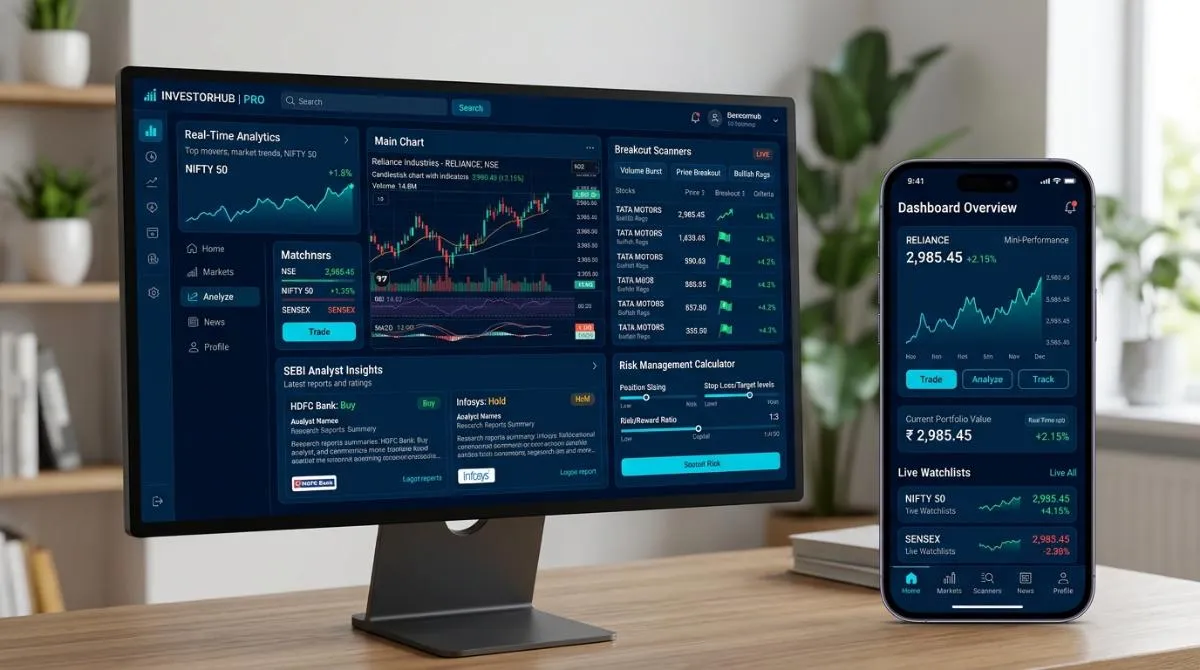
Infographic: End-to-end quantitative and algorithmic trading architecture for retail participants.
1 What is Algo Trading & How Does It Work?
Algorithmic Trading (Algo Trading) refers to the use of automated computer programs to execute financial market orders based on pre-programmed rules regarding timing, price, volume, and mathematical models.
Instead of staring at candlestick charts for 6 hours a day and second-guessing whether you should buy or sell, an algorithm continuously scans the live market feed. When predefined conditions are satisfied—such as a 5-minute candle closing above the 20-day high with 200% volume surge—it automatically shoots the order to your broker terminal in milliseconds.
2 Manual Discretionary Trading vs. Algorithmic Execution

Trading Aspect | Manual Discretionary Trading | Algorithmic / Rule-Based Trading |
|---|---|---|
Execution Speed | Slow (1 to 5 seconds to spot, decide, and click). | Ultra-fast (50 to 200 milliseconds via API). |
Psychological Discipline | Prone to greed, fear, hope, and hesitation. | 100% objective; follows rules without emotion. |
Multi-Asset Scanning | Limited to watching 2 to 4 charts simultaneously. | Scans 500+ stocks in real time across Nifty 500. |
Risk Management | Often skipped or moved during market panics. | Hardcoded stop-loss placed instantly upon fill. |
Consistency | Varies with sleep, stress, and mood. | Strict repeatable statistical process every day. |
3 The 4 Pillars of a Retail Algo Trading System
A complete automated trading architecture consists of four distinct layers:
Market Data Feed (WebSockets): Real-time tick-by-tick price, volume, and depth data streamed from your broker (e.g., Zerodha Kite Connect, Dhan, Upstox, Angel One).
Strategy Engine: The mathematical logic code that evaluates indicators, price patterns, and volume triggers.
Risk Management Module (RMS): The gatekeeper that verifies available margin, position size limits, maximum daily drawdown caps, and circuit checks before firing orders.
Order Execution API: The bridge that transmits limit/market orders to the exchange and confirms fills.
4 Avoiding the 3 Deadly Backtesting Traps
Many beginner algo developers create strategies that look like money-printing machines on historical data, only to lose money immediately in live markets. Beware of these traps:
Overfitting / Curve-Fitting: Tweaking 15 indicator parameters until the backtest shows a 90% win rate. When real market conditions change slightly, the system fails completely.
Ignoring Slippage & Latency: In backtests, every order fills at the exact breakout price. In live markets, slippage of 0.1% to 0.5% in volatile moves can turn a winning backtest into a losing live system.
Survivorship Bias: Backtesting only on currently listed high-performing Nifty 50 stocks, ignoring companies that were delisted or crashed during the backtest period.
5 Understanding SEBI Guidelines on Retail Algo Trading
SEBI has established strict regulations to safeguard the integrity of India's capital markets:
Broker-Provided APIs: Retail traders are legally permitted to use APIs provided by registered brokers for their own trading accounts.
Prohibition on Black-Box Schemes: Offering unauthorized algo strategies promising guaranteed returns without regulatory approval or registration is strictly banned.
Authentication Security: Mandatory two-factor authentication (TOTP) and daily session token generation are enforced across all retail APIs.
6 Quantitative Edge with DailyTrades.in
Building an algo trading engine from scratch requires extensive coding knowledge in Python, server hosting, and data management. DailyTrades.in bridges this gap by providing institutional-grade quantitative scanners and volume filters directly into an intuitive, actionable interface.
Frequently Asked Questions
Not necessarily. Modern platforms offer no-code strategy builders and webhooks that connect directly to broker APIs without writing raw Python or C++ code.
Yes. Using personal broker APIs for rule-based automated execution on your own account is completely legal under SEBI and exchange norms.
Yes. An algorithm simply executes your rules. If your underlying strategy has a negative statistical edge or market regime shifts, the algorithm will execute losses just as efficiently as profits.