Mastering Risk-Reward Ratio (RRR): The Secret Formula Used by Profitable Traders
Why win rate is an illusion and how a strict 1:2 or 1:3 Risk-to-Reward Ratio makes you consistently profitable even with a 40% accuracy rate.
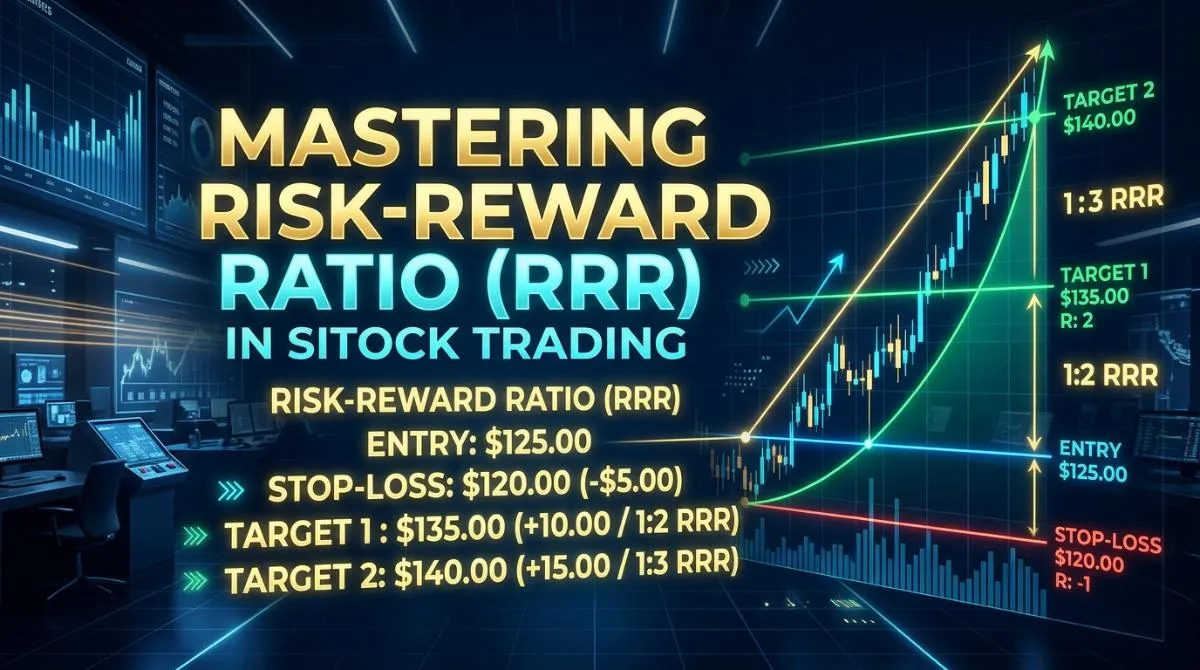
📌 Executive Key Takeaways
Win Rate is Overrated — A trader with an 80% win rate can go bankrupt if their losses are 5x larger than their wins.
Asymmetric Payoff — Targeting a minimum 1:2 or 1:3 Risk-Reward Ratio guarantees profitability even when you are wrong 6 out of 10 times.
The Invalidation Point — Your Stop-Loss should never be an arbitrary monetary amount; it must be placed at the technical point where your thesis is proven wrong.
Position Sizing Bridge — RRR only works when coupled with fixed-fractional position sizing (risking no more than 1% to 2% of total equity per trade).
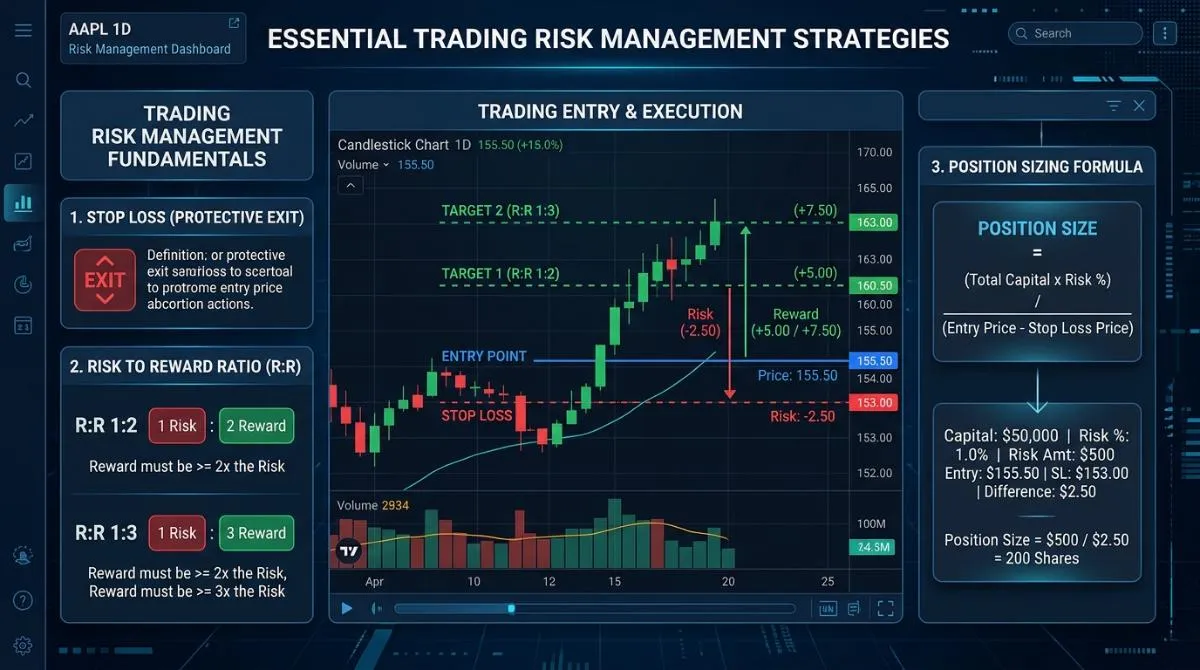
Infographic: How Risk-Reward Ratio generates positive expectancy even with a 40% win rate.
1 The Win Rate Myth: Why High Accuracy Fails
Ask any beginner what makes a great trader, and they will invariably answer: "An 80% or 90% winning strategy." In the trading world, this obsession with being right on every single trade is the primary cause of account blowups.
Consider two real-world traders over 100 trades:
Trader Amit (Win Rate: 80%): Wins 80 trades making ₹1,000 each (+₹80,000). But on the 20 losing trades, he ignores stop-losses and averages down, losing ₹5,000 per loss (-₹1,00,000). Net Result: Net Loss of -₹20,000!
Trader Rohit (Win Rate: 40%): Loses 60 trades risking only ₹1,000 each (-₹60,000). But on the 40 winning trades, he lets his 1:2.5 setups run, making ₹2,500 each (+₹1,00,000). Net Result: Net Profit of +₹40,000!
Rohit was wrong 60% of the time, yet he generated handsome profits. That is the astonishing mathematical power of Risk-to-Reward Ratio (RRR).
2 What is Risk-Reward Ratio (RRR)?

The Risk-Reward Ratio compares the potential loss you are willing to risk on a trade against the potential gain you expect to harvest.
• Your Target Price is ₹530 (Reward = ₹30).
• RRR = 10 / 30 = 1 : 3 (Risking ₹1 to make ₹3).
3 The Mathematical Expectancy Equation
Professional hedge fund managers judge strategies by Expectancy—the average amount you can expect to win or lose per rupee risked over a large sample size of trades:
• Loss %: Probability of losing trade (1 - Win %).
• A positive expectancy system produces steady upward compounding equity curves.
4 The Win Rate vs. RRR Profitability Matrix
Here is the exact minimum win rate required to break even across different Risk-Reward profiles:
Risk : Reward Ratio | Minimum Break-Even Win Rate | Profitability with 50% Win Rate |
|---|---|---|
1 : 1 | 50.0% | Zero (Break-even after commissions) |
1 : 1.5 | 40.0% | Moderately Profitable |
1 : 2.0 | 33.3% | Highly Profitable (+50% Edge) |
1 : 3.0 | 25.0% | Elite Institutional Level (+100% Edge) |
5 Step-by-Step: How to Calculate RRR on Charts
Identify the Invalidating Technical Level: Never pick an arbitrary stop loss. Look for structural support, previous swing low, or VWAP invalidation.
Identify Technical Resistance: Find the next liquidity pool, prior swing high, or Fibonacci extension level.
Check the Ratio Before Entering: Measure the distance. If the distance to the target is not at least twice the distance to your stop loss, skip the trade! There is no shame in saying "No" to a 1:1 setup.
6 Golden Rules for Executing 1:2 and 1:3 Trades
Never Risk More than 1-2% of Account: If your account has ₹2,00,000, your maximum monetary loss on any single trade should never exceed ₹2,000 to ₹4,000.
Trail Stop Loss Once 1:1 is Achieved: Move your stop loss to break-even once price reaches 1:1 reward to eliminate downside risk.
Avoid Premature Profit Taking: Beginners cut winning trades at +₹500 out of fear and let losing trades run to -₹3,000 out of hope. Invert this psychology!
Frequently Asked Questions
Yes! By entering near critical structural inflection zones (such as opening range breakouts or volume absorption levels), you can capture high momentum expansion while keeping stop losses tight.
If your stop loss hits too often, either your trade timing is premature (entering before confirmation) or your stop is placed too close without accounting for normal market volatility (ATR).
DailyTrades features built-in automated risk calculators and breakout scanners that pre-calculate the exact RRR, entry trigger, and position sizing before you take a trade.