SEBI RA vs IA: Key Differences Between Research Analyst and Investment Adviser Explained
Confused between a Research Analyst (RA) and an Investment Adviser (IA)? Learn the crucial differences in regulations, scope of services, fee models, and which one suits your trading journey.
📌 Executive Key Takeaways
Distinct Regulations — Research Analysts are governed by SEBI (RA) Regulations, 2014, whereas Investment Advisers fall under SEBI (IA) Regulations, 2013.
General vs Personalized — RAs issue security-specific research and trade recommendations to broad subscribers, while IAs must conduct individual risk profiling and personalized financial planning.
Fee Caps — SEBI enforces an annual ₹1,25,000 fee cap (or 2.5% of AUA) on Investment Advisers, while RA fee structures are based on research subscription value.
Target Audience — Active traders seeking specific breakout setups benefit most from an RA, while wealth-builders seeking holistic portfolio allocation need an IA.
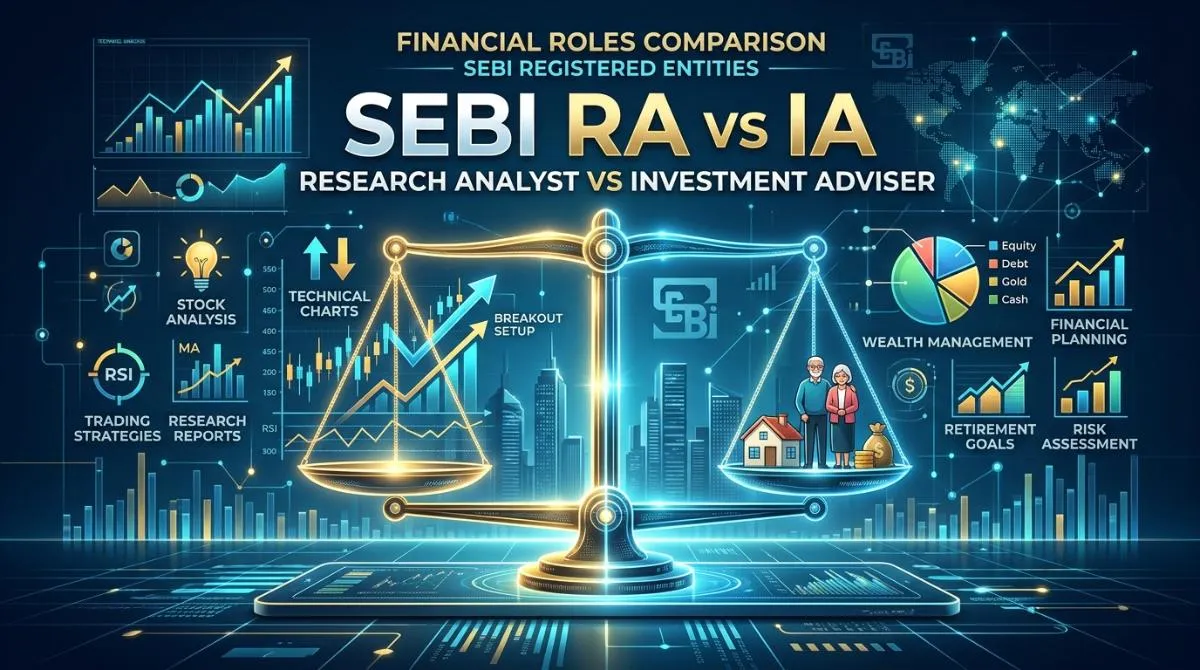
Infographic: SEBI Research Analyst vs Investment Adviser operational and regulatory comparison.
1 Introduction: The Need for Clarity
When seeking professional stock market guidance in India, retail investors frequently encounter two acronyms: RA (Research Analyst) and IA (Investment Adviser). While both are prestigious SEBI-regulated intermediaries, their legal mandates, compliance obligations, fee structures, and deliverables are fundamentally different.
Choosing the wrong intermediary can lead to mismatched expectations—such as expecting an RA to do personalized tax and retirement planning, or expecting an IA to provide intraday Nifty momentum breakouts.
2 Role & Scope of a Research Analyst (RA)

A Research Analyst (RA) is regulated under the SEBI (Research Analysts) Regulations, 2014. Their core responsibility is to analyze financial instruments, study technical charts, track quarterly earnings, evaluate macro trends, and publish actionable research reports.
Target Deliverable: Specific stock ideas, breakout strategies, swing setups, and sector reports.
Audience: Mass audience or registered subscribers who evaluate the published setup and execute trades according to their individual risk appetite.
Execution Mandate: The client executes their own trades; the RA does not take control of capital.
3 Role & Scope of an Investment Adviser (IA)
An Investment Adviser (IA) is regulated under the SEBI (Investment Advisers) Regulations, 2013. Their role resembles that of a personal wealth doctor or certified financial planner.
Mandatory Risk Profiling: Before offering any advice, an IA is legally bound to conduct a thorough financial health check, assessing the client's income, liabilities, age, and risk tolerance.
Personalized Financial Plan: Advice must be tailored specifically to that individual's life goals (e.g., retirement, child education, asset allocation between debt, equity, and gold).
Strict Separation of Distribution: SEBI mandates a strict separation between advising and execution. An IA cannot earn distribution commissions from mutual funds or products they advise.
4 Head-to-Head Comparison: RA vs IA
Key Dimension | SEBI Research Analyst (RA) | SEBI Investment Adviser (IA) |
|---|---|---|
Primary Regulation | SEBI (Research Analysts) Reg, 2014 | SEBI (Investment Advisers) Reg, 2013 |
Nature of Service | Research reports, stock analysis & trade setups. | Holistic financial planning & portfolio advisory. |
Individual Risk Profiling | Not mandatory for broad research reports. | Strictly mandatory before giving any advice. |
Focus Area | Security-specific technical and fundamental edge. | Asset allocation, net worth goals, and risk capacity. |
Fee Structure | Subscription-based research access. | Capped at ₹1.25 Lakh/yr or 2.5% of AUA by SEBI. |
Best For | Active intraday, swing traders & tactical investors. | Long-term wealth creators needing personalized plans. |
5 Suitability Analysis vs Broad Research
The defining legal difference between an RA and an IA lies in Suitability:
If an advisor recommends a high-beta mid-cap stock to a 75-year-old retired pensioner with low risk tolerance, an Investment Adviser (IA) would be guilty of a severe regulatory violation because the advice was not "suitable." However, a Research Analyst (RA) publishes the research report for the general market; it is up to the individual investor to determine if that setup fits their portfolio rules.
6 Which Service Do You Actually Need?
To decide whether you should subscribe to an RA or hire an IA, answer these simple diagnostic questions:
Choose a Research Analyst (RA) if: You already know how to place orders on your broker terminal, understand basic risk management, and need high-probability trade setups, volume breakout alerts, and sector momentum data.
Choose an Investment Adviser (IA) if: You have a lump sum of capital, don't want to follow daily market fluctuations, and need someone to build a diversified 5-to-10 year portfolio across mutual funds, debt, and bluechips.
Frequently Asked Questions
Yes, but SEBI enforces strict Chinese walls, distinct registration numbers, and segregated operational teams to prevent conflicts of interest.
Yes, genuine research reports typically provide technical support levels, resistance targets, and stop-loss invalidation prices backed by clear analytical rationale.
Absolutely not. SEBI strictly forbids both RAs and IAs from guaranteeing or implying assured returns. Market returns are inherently subject to market risk.