1 The Illusion of the 'Green Day'
Consider a typical day in the life of an active Indian retail trader: by 03:15 PM, your terminal displays a gross realized gain of +₹1,200 across 12 rapid intraday scalps. You shut down your computer feeling proud of your green day.
The next morning, the contract note arrives in your email inbox: net settlement = -₹280. Where did your profit go? Brokerage consumed ₹480, Securities Transaction Tax (STT) ate ₹510, GST took ₹180, and exchange turnover charges drained the rest.

2 The Comprehensive Breakdown of Indian Trading Frictions
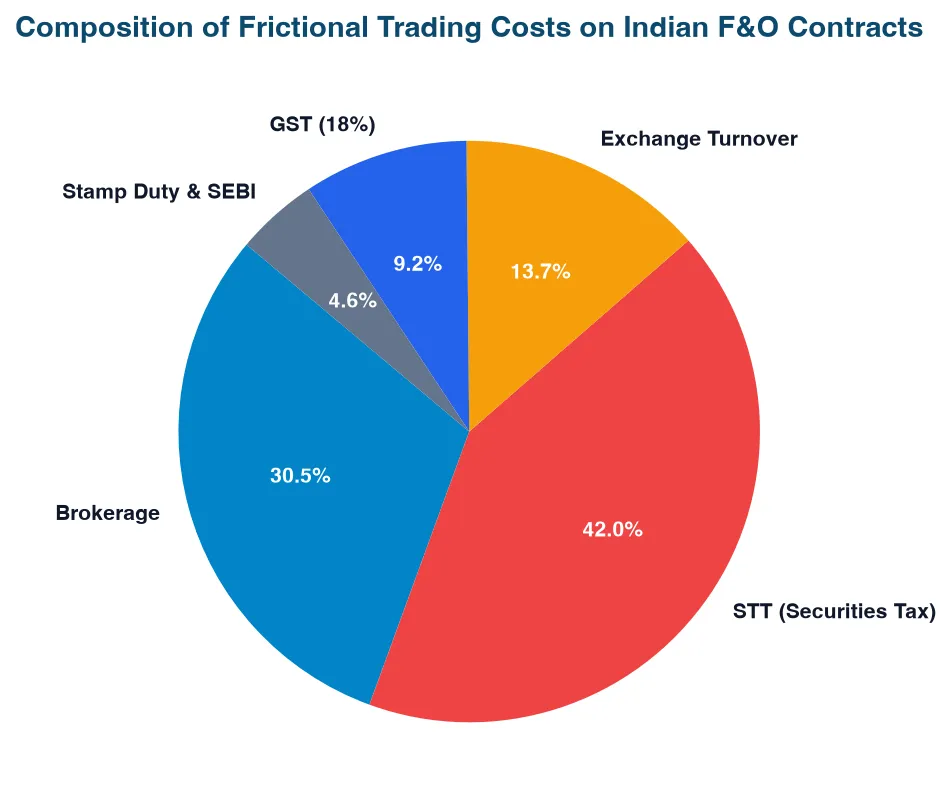
When you execute an order in the Indian equity or derivative ecosystem, you are paying 6 separate regulatory and commercial fees:
1. Brokerage Fee: Charged by discount brokers (typically ₹20 per executed order or 0.03% on turnover).
2. Securities Transaction Tax (STT): Statutory direct tax levied by the Central Government. Following recent revisions, STT on futures stands at 0.02% and options premium sales at 0.1%.
3. Exchange Turnover Charges: Levied by NSE/BSE on gross traded turnover.
4. Goods & Services Tax (GST): 18% tax levied on the sum of brokerage + exchange charges.
5. SEBI Turnover Charges: ₹10 per crore of traded turnover for regulatory maintenance.
6. Stamp Duty: State-level levy charged on buy-side turnover.
Execution Metric | Disciplined Trader (2 Trades/Day) | Over-Trader (15 Trades/Day) |
|---|---|---|
Monthly Trades | 40 orders | 300 orders |
Monthly Brokerage (@ ₹20) | ₹800 | ₹6,000 |
Estimated STT & Taxes | ₹1,100 | ₹9,800 |
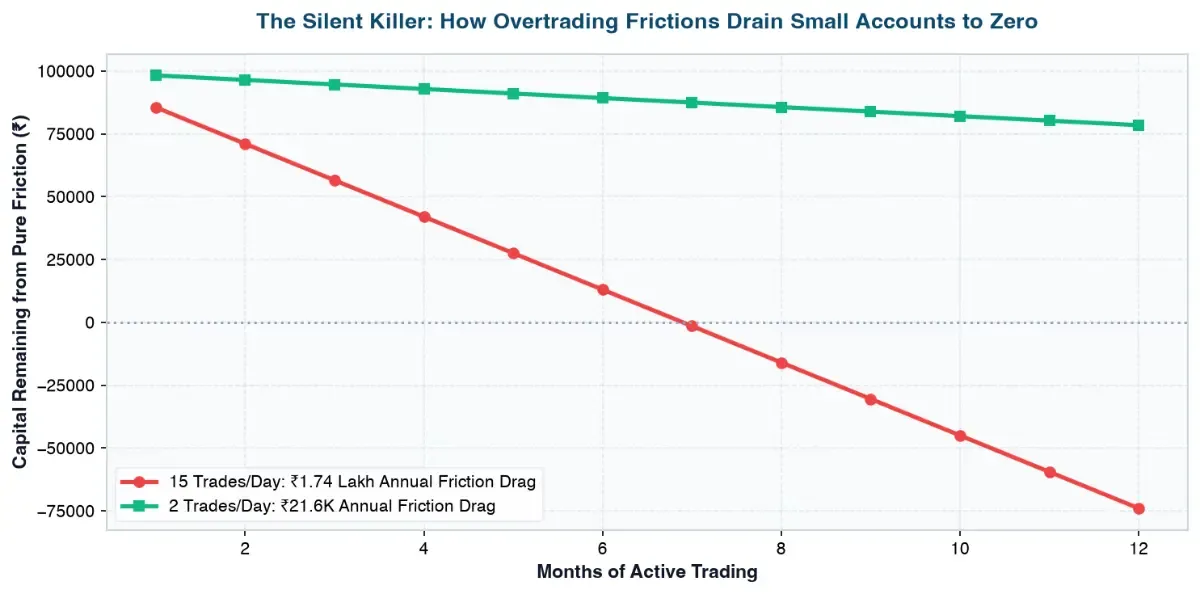
Annual Frictional Drag | ₹22,800 | ₹1,89,600 |
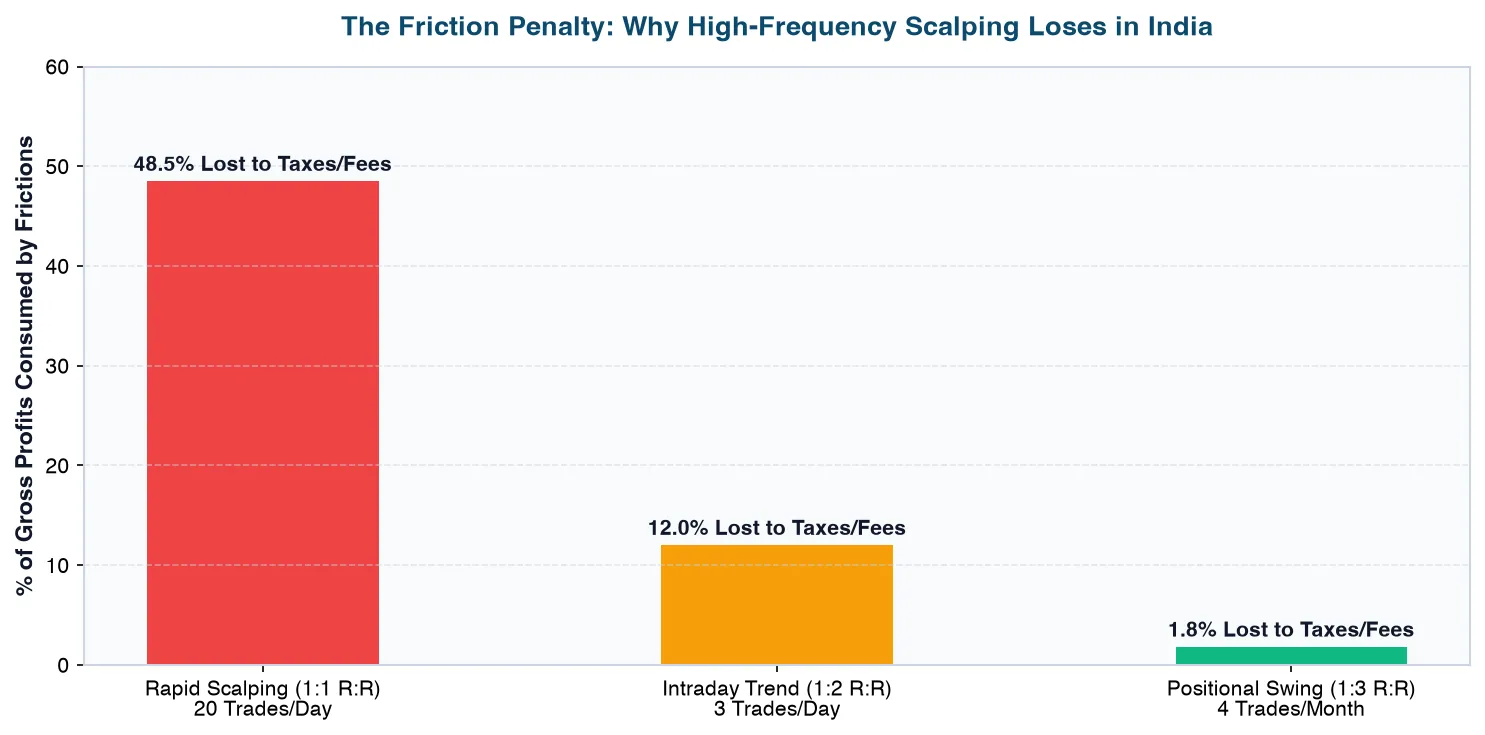
3 The Mathematical Proof: Why 1:1 Scalping Is a Guaranteed Trap
Many beginners attempt rapid scalping, aiming to capture 5 points with a 5-point stop-loss (1:1 Risk-to-Reward). Even with a 55% win rate, the frictional drag of ₹80–₹120 per round-trip trade ensures an asymptotic spiral toward zero.